Mathematical Modeling and Experimental Validation of Ultrafast Nonlinear Light-Matter Coupling associated with Filamentation in Transparent Media
The ability to control, propagate and generate intense light filaments at remote locations in the atmosphere with concomitant plasma strings and white-light continua provides exciting opportunities for the DOD across a broad landscape of applications. A subset of these applications include remote generation of a super-continuum for absorption monitoring of trace gases in the atmosphere, laser induced breakdown spectroscopy, filament formation for terahertz generation and for remotely establishing electrically conducting channels, localized EMP generation, low-divergence (below diffraction limit) beam propagation and remote guide-star beacons for adaptive optics. The multidisciplinary university research initiative grant (AFOSR FA9550-10-1-0561) has the University of Arizona as the lead institution with five external universities as partners. The focus of the MURI project is to gain a fundamental understanding of all physical processes involved in the propagation of ultra-intense femtosecond laser pulses through the atmosphere with the aim of designing new forms of robust laser beams that can propagate over much longer distances than conventional beams. Applications of this novel atmospheric “light-string” are many and varied including: femtosecond atmospheric LIDAR and remote detection of pollutants, explosive, chem./bio agents; artificial guidestar for turbulence correction in astronomy, remote plasma generation for Laser Induced Breakdown Spectroscopy (LIBS) and redirection of lighting strikes.
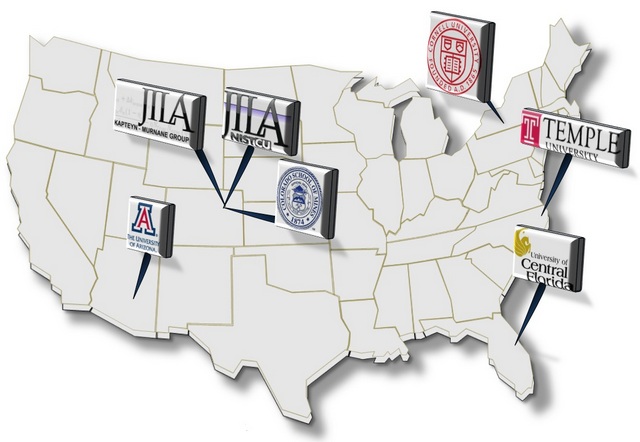
The assembled MURI team, with the core mathematics effort housed at the Arizona Center for Mathematical Sciences (ACMS), University of Arizona, brings a unique mix of mathematics, theoretical physics and ultrafast experimental laser science expertise to tackle a truly grand challenge problem. External theory groups involving the University of Colorado and the University of Central Florida further augment a strong Arizona core. An in-house ACMS and external experimental teams at the JILA, University of Colorado, Cornell University, Temple University and the Colorado School of Mines provide the critical experimental validation backing for tests of theory/simulation results generated by the core mathematics/theory groups.
A central theme of our proposed research is a paradigm shift away from phenomenology and towards a rigorous mathematically and physically self-consistent foundation that will be the key enabler for development of critically important basic research breakthroughs in ultrafast laser propagation in gaseous and condensed media and future dual use technology applications. A major project investment is focused on training and education of young researchers. From the outset, we recognize severe shortcomings in our understanding of fundamental nonlinear processes associated with the propagation of intense ultrashort laser pulses in the above media. Our project breaks the problem down into 4 critical phases:
- Initial pulse launch conditions - spatial beam and temporal pulse shaping and control,
- Nonlinear interaction and ultrafast photoionization - plasma initiation,
- Coupling of ultrashort pulses to established plasmas
- Multiple filament interaction in propagating multi-Terawatt pulses.
The assembled MURI team consists of a core applied mathematics and theoretical physics (Moloney, Kolesik, Wright, Newell, Glasner, Brio, Venkataramani) and experimental femtosecond optics (Polynkin) at ACMS and external theoretical physicists Becker and Jaron-Becker at JILA, University of Colorado, Christodoulides (Central Florida) and experimentalists Murnane, Kapetyn (University of Colorado), Levis (Temple), Gaeta (Cornell) and Durfee (Colorado School of Mines).
The MURI team will maintain strong collaborative links with Air Force Research scientists (Roach at AFRL Kirtland and Albanese (Brooks City AFB). The MURI team will work in close collaboration with AFRL (Kirtland) to transition expertise, research personnel and discoveries to their AFRL TW laser facility for field tests.

Experimental facility supporting MURI
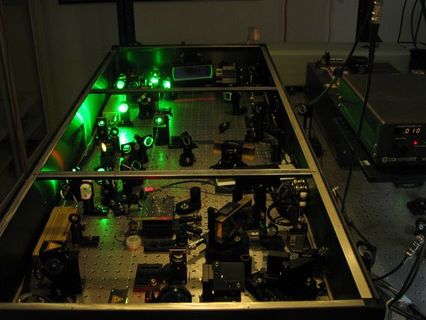
This lab is a dedicated facility that provides experimental support for the on-going theory/simulations program in extreme nonlinear optics at the Arizona Center for Mathematical Sciences. The lab facilities have been assembled under support from the Defense University Research Instrumentation Program (DURIP) by the US Air Force Office of Scientific Research. We are located in the Meinel Building of the College of Optical Sciences, on the University of Arizona campus in Tucson. The main focus of our experiments is femtosecond laser filamentation in gaseous media and related phenomena.

Computing facility supporting MURI
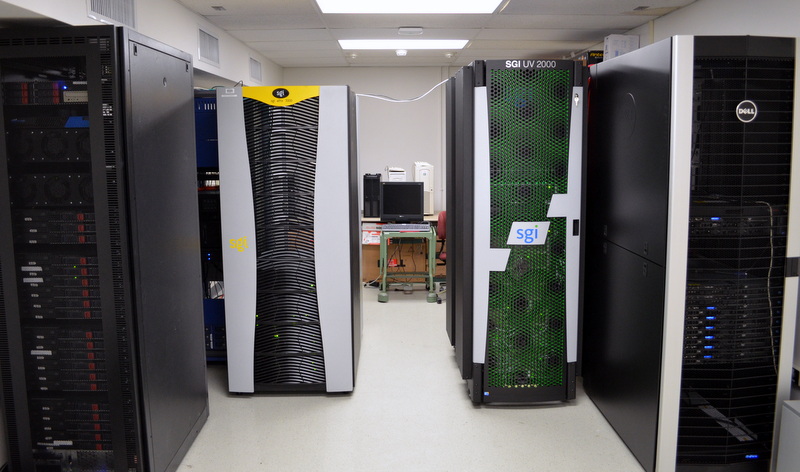
An in-house supercomputing laboratory provides high performance computing, storage, and visualization resources to MURI researchers. The primary computing resources consist of a UV2000 from Silicon Graphics. This latest generation computer, released June 2012 and installed at the ACMS in September 2012, is scalable, coherent shared memory computer. The SGI UV2000 operates just like a single workstation (on one system image any program has access to all the cores and all the memory of the system); it is far less complex to program than traditional cluster systems with many distrobuted nodes. Also available are a SGI Altix XE Cluster and a range of nVidia GPU workstations and multi GPU equipped servers. These facilities have been assembled under support from the Defense University Research Instrumentation Program (DURIP) by the US Air Force Office of Scientific Research.
MURI News
Professor Margaret Murnane, a winner of multiple prestigious awards, including a MacArthur Fellowship in 2000, won the following awards during the life of the MURI:
- 2012 Willis Lamb Award for Laser Science and Quantum Optics (shared with Henry Kapteyn)
- 2012-2014 Chair, President's Committee for the US National Medal of Science
- 2011 Boyle Medal of the Royal Dublin Society
- 2010 Appointed to the President's Committee for the US National Medal of Science
- 2010 R.W. Wood Prize of the Optical Society of America (shared with Henry Kapteyn)
- 2010 Arthur L Schawlow Prize in Laser Science by American Physical Society (shared w Henry Kapteyn)
|